GoodSleep
· Updated: · GoodSleep Team · science-of-sleep · 8 min read
The Science of Sleep
What is Sleep?
Every night you lie down, close your eyes, and a few minutes later—gone. Eight hours pass, and you wake up. It happens so routinely that we rarely stop to ask: what actually just happened?
Sleep isn’t your brain “shutting down.” Scientists used to think that. For decades, the assumption was that sleep was a passive state—the brain at rest, nothing much going on. Modern neuroscience has completely overturned this view. Sleep is an active, highly organized process. Your brain is busy doing critical maintenance work that simply can’t happen while you’re awake.
We spend roughly a third of our lives asleep. By age 75, that’s about 25 years. Evolution wouldn’t preserve such a vulnerable state unless it was absolutely essential.
The Two-Process Model of Sleep Regulation
Two biological systems control when you feel sleepy and when you feel alert. They work together, but they’re completely independent.
Process S: Sleep Pressure (Homeostatic Drive)
From the moment you wake up, a chemical called adenosine begins accumulating in your brain. Adenosine is a byproduct of cellular energy consumption—the more active your neurons, the more adenosine builds up. This accumulation creates “sleep pressure” that grows stronger throughout the day.
Caffeine works by blocking adenosine receptors, which is why coffee makes you feel alert. However, caffeine doesn’t eliminate adenosine—it merely masks its effects. Once caffeine wears off, the accumulated adenosine hits your receptors all at once, causing the familiar “caffeine crash.”
During sleep, your brain clears adenosine, resetting the system for the next day. This is why sleep deprivation creates such intense drowsiness—adenosine levels remain elevated without adequate clearance time.
Process C: Circadian Rhythm
Your circadian rhythm is a roughly 24-hour internal clock controlled by the suprachiasmatic nucleus (SCN), a tiny region in the hypothalamus containing about 20,000 neurons. The SCN coordinates timing signals throughout your body, influencing not just sleep but also hormone release, body temperature, and metabolism.
Light is the primary signal that synchronizes your circadian clock with the external world. Specialized cells in your retina called intrinsically photosensitive retinal ganglion cells (ipRGCs) detect light—particularly blue wavelengths around 480nm—and send signals directly to the SCN.
When these two processes align—high adenosine levels coinciding with your circadian “sleep window”—you experience optimal sleep onset. Disruptions to either system, such as jet lag (circadian) or an irregular sleep schedule (homeostatic), can cause significant sleep difficulties.
Stages of Sleep
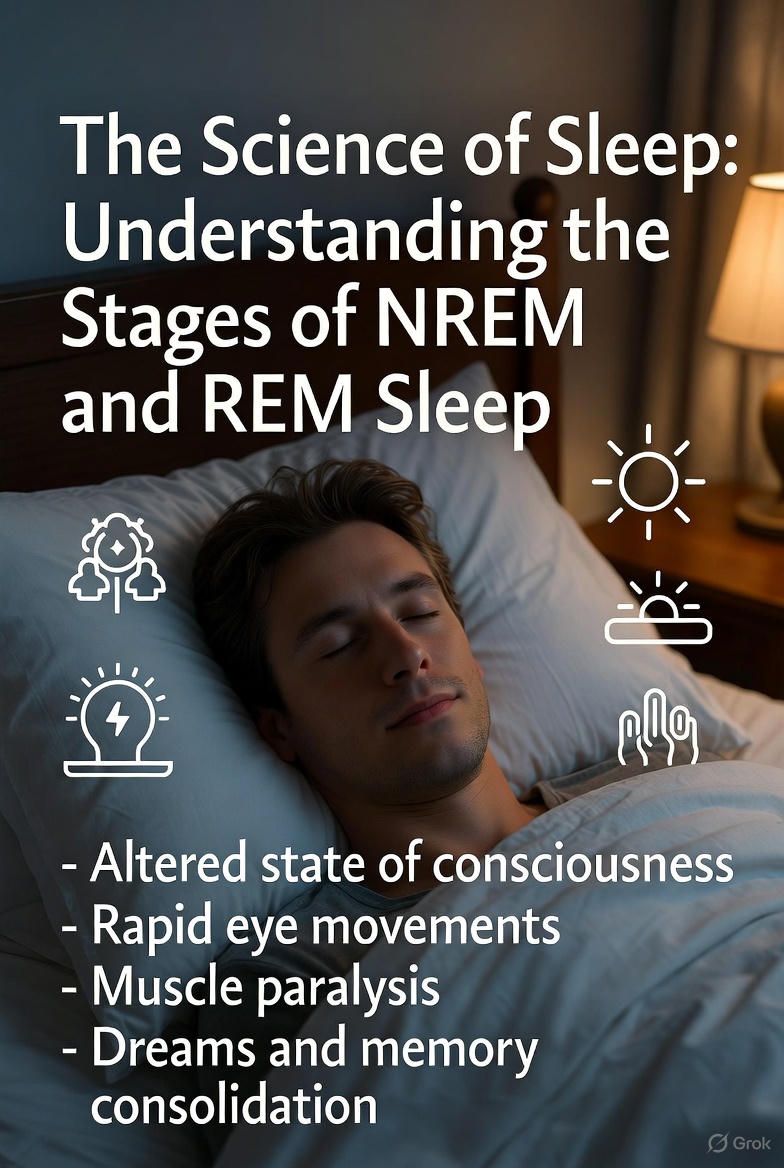
Sleep occurs in a recurring cycle of NREM (non-rapid eye movement) and REM (rapid eye movement) stages. A complete cycle takes approximately 90-110 minutes, and most adults experience 4-6 cycles per night.
NREM Sleep
NREM sleep comprises about 75-80% of total sleep time and is divided into three stages:
N1 (Stage 1): The transition from wakefulness to sleep, typically lasting 1-7 minutes. Brain waves slow from the alpha rhythms of relaxed wakefulness to theta waves. Muscle tone decreases, and you may experience hypnic jerks—sudden muscle contractions that sometimes wake you briefly. People awakened from N1 often report they weren’t actually asleep.
N2 (Stage 2): A deeper sleep state that accounts for 45-55% of total sleep time in adults. Two distinctive brain wave patterns emerge during N2:
- Sleep spindles: Bursts of rapid neural activity lasting 0.5-2 seconds, believed to play a role in memory consolidation and sensory gating (blocking external stimuli from waking you)
- K-complexes: Large, slow waves that may help maintain sleep and process external stimuli without fully waking
N3 (Stage 3): Also called slow-wave sleep (SWS) or deep sleep. The brain produces delta waves—high-amplitude, low-frequency oscillations. This stage is most prevalent in the first third of the night and decreases with age. Waking someone from N3 is difficult, and if awakened, they typically feel groggy and disoriented (sleep inertia).
For strategies to increase deep sleep, see our guide on How to Get More Deep Sleep.
REM Sleep
REM sleep is characterized by rapid eye movements, increased brain activity approaching waking levels, and temporary paralysis of voluntary muscles (atonia). This paralysis prevents you from physically acting out dreams.
REM periods lengthen as the night progresses. The first REM episode may last only 10 minutes, while later episodes can extend to 60 minutes. Most vivid, narrative-style dreaming occurs during REM, though dreams can occur in NREM stages as well.
Learn more about this stage in What is REM Sleep and Why is it Crucial for Your Brain?.
Why Do We Sleep? The Functions of Sleep
Physical Restoration
During deep sleep, the pituitary gland releases growth hormone, which stimulates tissue repair, muscle growth, and protein synthesis. The immune system also ramps up activity during sleep—studies show that people who sleep less than 7 hours per night are nearly three times more likely to develop a cold after viral exposure compared to those sleeping 8+ hours.
Brain Maintenance: The Glymphatic System
In 2012, researchers at the University of Rochester discovered the glymphatic system—a waste clearance pathway that removes metabolic byproducts from the brain. This system is nearly 10 times more active during sleep than during wakefulness.
One key substance cleared by the glymphatic system is beta-amyloid, a protein that accumulates in the brains of Alzheimer’s patients. Chronic sleep deprivation leads to beta-amyloid buildup, suggesting a potential link between poor sleep and neurodegenerative disease.
Memory Consolidation
Sleep plays a critical role in converting short-term memories into long-term storage. Different sleep stages appear to consolidate different types of memory:
- Declarative memory (facts and events): Primarily consolidated during slow-wave sleep
- Procedural memory (skills and habits): Strongly associated with REM sleep and Stage 2 NREM
- Emotional memory: Processed during REM sleep, which may explain why sleep deprivation impairs emotional regulation
A 2003 study in Nature Neuroscience by Sara Mednick and colleagues found that a midday nap containing both slow-wave and REM sleep restored learning capacity that had declined over the course of the day.
Metabolic Regulation
Sleep deprivation disrupts hormones that regulate appetite. After just one night of poor sleep:
- Ghrelin (hunger hormone) increases by approximately 15%
- Leptin (satiety hormone) decreases by approximately 15%
This hormonal shift creates increased appetite, particularly for high-calorie, carbohydrate-rich foods. Epidemiological studies consistently show that short sleep duration is associated with higher body mass index and increased obesity risk.
How Much Sleep Do You Need?
Sleep requirements vary by age and individual factors. The National Sleep Foundation recommends:
| Age Group | Recommended Hours |
|---|---|
| Newborns (0-3 months) | 14-17 hours |
| Infants (4-11 months) | 12-15 hours |
| Toddlers (1-2 years) | 11-14 hours |
| Preschoolers (3-5 years) | 10-13 hours |
| School-age (6-13 years) | 9-11 hours |
| Teenagers (14-17 years) | 8-10 hours |
| Adults (18-64 years) | 7-9 hours |
| Older adults (65+) | 7-8 hours |
Individual variation exists within these ranges. Some people function well on 7 hours while others need 9. Genetic factors influence sleep need—researchers have identified mutations in genes like DEC2 that allow some individuals to thrive on as little as 6 hours.
The best indicator of adequate sleep is how you feel during the day. If you consistently wake without an alarm, feel alert throughout the day, and don’t experience afternoon energy crashes, you’re likely getting sufficient sleep.
The Consequences of Sleep Deprivation
Cognitive Impairment
After 17-19 hours without sleep, cognitive performance deteriorates to levels equivalent to a blood alcohol concentration of 0.05%. At 24 hours of wakefulness, impairment reaches levels comparable to legal intoxication (0.10% BAC).
Sleep-deprived individuals show deficits in:
- Attention and vigilance
- Working memory
- Decision-making and judgment
- Reaction time
- Creative problem-solving
Health Risks
Chronic sleep restriction (defined as regularly sleeping less than 7 hours) is associated with:
- Cardiovascular disease: 48% increased risk of coronary heart disease
- Type 2 diabetes: Impaired glucose tolerance and insulin sensitivity
- Weakened immunity: Reduced vaccine effectiveness and increased infection susceptibility
- Mental health disorders: Higher rates of depression and anxiety
- Mortality: Studies suggest sleeping less than 6 hours per night is associated with a 12% increased risk of premature death
Microsleeps
When severely sleep-deprived, the brain can enter brief, involuntary sleep episodes lasting 1-30 seconds—even with eyes open. These microsleeps are particularly dangerous while driving or operating machinery. The AAA Foundation for Traffic Safety estimates that drowsy driving causes approximately 328,000 crashes annually in the United States.
Sleep Across the Lifespan
Infants and Children
Newborns spend about 50% of their sleep time in REM—far more than adults. This elevated REM sleep is thought to support rapid brain development during early life. Sleep patterns consolidate over the first year, with most infants developing a day-night rhythm by 3-4 months.
Adolescents
During puberty, the circadian rhythm shifts later—a phenomenon called sleep phase delay. Teenagers naturally feel alert later at night and sleepy later in the morning. This biological shift conflicts with early school start times, contributing to chronic sleep deprivation in this age group.
Older Adults
Sleep architecture changes with age. Older adults experience:
- Less time in deep sleep (N3)
- More frequent nighttime awakenings
- Earlier sleep timing (advanced sleep phase)
- Reduced sleep efficiency (time asleep vs. time in bed)
These changes are normal but can be exacerbated by medical conditions, medications, and reduced physical activity.
Improving Your Sleep
Understanding sleep science provides a foundation for better sleep habits. Key principles include:
Maintain consistent timing: Go to bed and wake up at the same time daily, including weekends. This reinforces your circadian rhythm.
Respect your sleep pressure: Avoid long naps late in the day, which reduce adenosine levels and make nighttime sleep more difficult.
Manage light exposure: Get bright light in the morning to anchor your circadian rhythm, and dim lights in the evening to allow melatonin release.
Create optimal conditions: A cool (65-68°F / 18-20°C), dark, quiet bedroom supports sleep onset and maintenance.
For a detailed breakdown of sleep stages and how to optimize each one, explore our Ultimate Guide to Sleep Cycles.
Assessing Your Sleep
If you’re concerned about your sleep quality, validated assessment tools can provide useful insights:
- Pittsburgh Sleep Quality Index (PSQI): Evaluates overall sleep quality over the past month
- Epworth Sleepiness Scale (ESS): Measures daytime sleepiness levels
- Sleep Cycle Calculator: Helps determine optimal bedtimes based on sleep cycle timing
Sleep is not a luxury or a sign of laziness—it’s a biological necessity as fundamental as food and water. The science is clear: prioritizing sleep is one of the most impactful things you can do for your physical health, mental clarity, and overall quality of life.